
COMPASS: Curriculum On the Management and Promotion of Appropriate Social Skills
Playgroup for DK through 1st graders
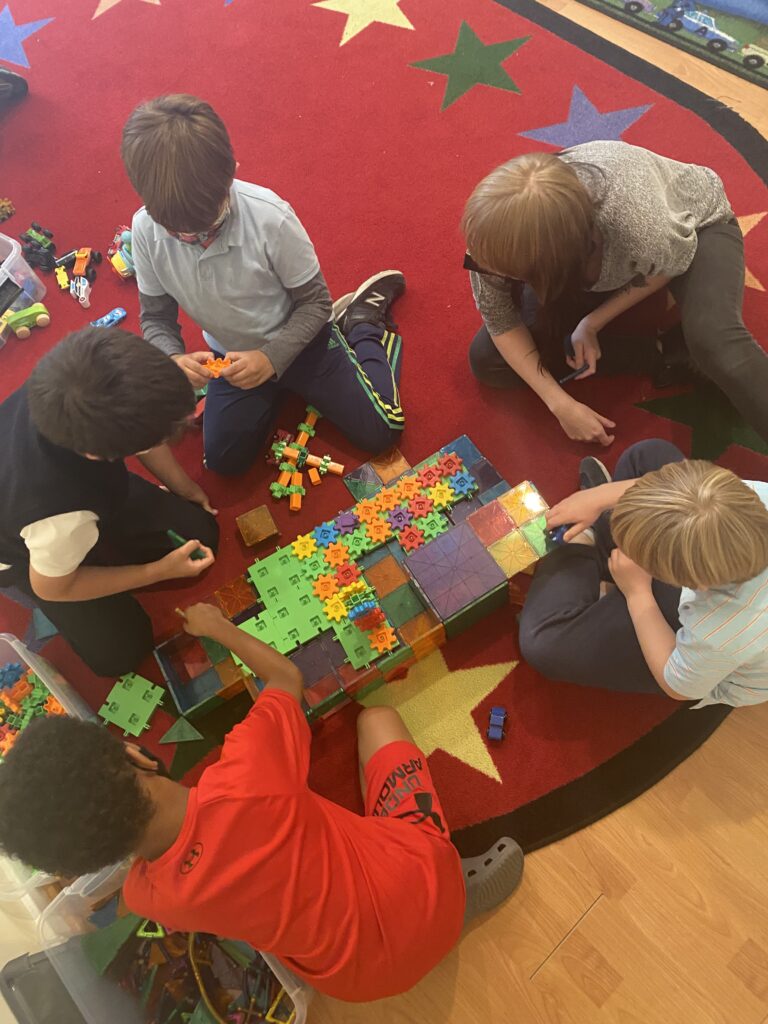
The goal of the COMPASS group is to promote positive social skills in children who are either shy/anxious or who display overly assertive behavior towards others during play. Each group is composed of approximately 6-8 children. Through puppet shows, role plays, and/or structured activities, your child will be given brief instruction on how to handle a difficult social situation by using appropriate social skills. Despite our proximity to Hollywood, the puppet shows have low production value but always delight the children. They also are a great way to take the “ego” out of learning social skills. Oftentimes, children are given social skills feedback in the moment, during high intensity emotions. This is the worst time to learn as the amygdala has taken over and turned off the prefrontal cortex! When the puppets have a hard time socially, your child is able to reflect on the situation calmly and without shame, anger, or excitement getting in the way. Your child will then be encouraged to rehearse the skill being taught during real-world play and activities and will be coached during this practice. These methods ensure that new neural pathways are being formed, encoding over default ways of responding that may not be appropriate or effective in making and/or keeping friends.
Although it is important for us to teach your child the basic social skills in our weekly group sessions, it is also important that you know how to reinforce those skills at home. Included in the cost of the program are periodic parent education sessions on a variety of social skills topics plus email updates specific to your child’s group. These updates include activities and techniques for moving the needle further and faster with respect to social-emotional development and reciprocal friendships in the home and school settings.
Curriculum
In the COMPASS curriculum, your child will learn:
- sharing toys and materials with peers
- taking turns during games, large group activities, and in conversation
- obeying game rules instead of cheating or making them up on the fly
- body boundary awareness and the difference with “on accident” and “on purpose”
- leading/joining with a fun idea–joining in by adding positively to the play of peers
- sustaining play through the use of behaviors and conversational skills that promote reciprocal play
- listening/two-way conversation–role plays and organic opportunities to practice conversation
- talking nicely to other children both when emotions run high and simply to be friendly
Is COMPASS right for me and my child?
Does your child have difficulties sharing toys or games with other children? Does your child become impatient in situations when s/he needs to take turns? Does your child have a hard time taking turns when it comes to which game is going to be played or which toy will be played with? Does your child play by the rules at games or tend to cheat? Does your child make up new rules as the game goes on so that s/he will win? Is your child competitive and a sore loser–even a bad winner (bragging, etc.)? Does your child have to always do what s/he wants to do during play? Does your child have a hard time coming up with elaborate play themes during pretend or make-believe play? Does your child want friends, but just doesn’t get invited to birthday parties or on play dates very often? Does your child play with the other kids, but when you really take a closer look, s/he is just playing alone next to the other kids? Does your child tend to make negative statements or annoying comments to other kids and it turns them off? Does your child crowd other children–get into their personal space? Does your child have a hard time listening to other children’s ideas during play? Is your child bossy?
COMPASS deals with all of these issues and more. Most importantly, parents are included in every aspect of COMPASS, allowing for generalization of the skills from Compass Clinic’s playroom to your home. Compass Clinic realizes that it is critical for your child to be able to use the COMPASS skills on play dates. Therefore, the person who most needs to know how to reinforce these skills is you–the parent! In the COMPASS Program, parents learn how to become their child’s own social skills coach.
Many parents ask about the types of children who are in the COMPASS groups. COMPASS is designed for ALL children with social skills difficulties–or even without! And, COMPASS is specifically meant to be for children who are doing well in most other areas and can benefit from our cognitively-loaded program, which is why the intake procedure is so important for ensuring that the groups are composed of children who will blend well together. While children with diagnoses such as Attention-Deficit/Hyperactivity Disorder, Autism Spectrum Disorders, and Anxiety Disorders will almost certainly be in every group, we certainly have a number of children who have no diagnosis and are receiving services for the first time. Dr. Rich has been collecting outcome data on COMPASS and has found that many positive benefits are experienced by children with and without diagnoses.